Quick answer
A 7-pin plug (the 12N type, to ISO 1724) carries the basic road lighting: indicators, tail and marker lights, brake lights, rear fog and an earth. A 13-pin plug (ISO 11446) does the same job in one connector and adds the caravan or trailer “living” circuits such as reversing light, permanent power and a switched charging feed. If your trailer only needs lights, a 7-pin 12N is all you need. If it also draws power for a fridge, charger or interior lighting, you want a 13-pin or the older twin 7-pin (12N plus 12S) setup.
| Connector | Standard | What it runs |
|---|---|---|
| 7-pin 12N | ISO 1724 | Indicators, tail/marker, brake, rear fog, earth |
| 7-pin 12S | ISO 3732 | Reversing, permanent and switched power, auxiliary earths |
| 13-pin | ISO 11446 | All 12N functions plus the 12S “living” circuits in one plug |
Wiring a trailer plug is one of those jobs that looks fiddly until you have the colours in front of you, and then it takes ten minutes. This is our plain-English reference for the two connectors you will actually meet on UK roads: the 7-pin 12N and the 13-pin. Get the pins right and your lights work first time, every time, which is exactly what you want before you pull onto a motorway.
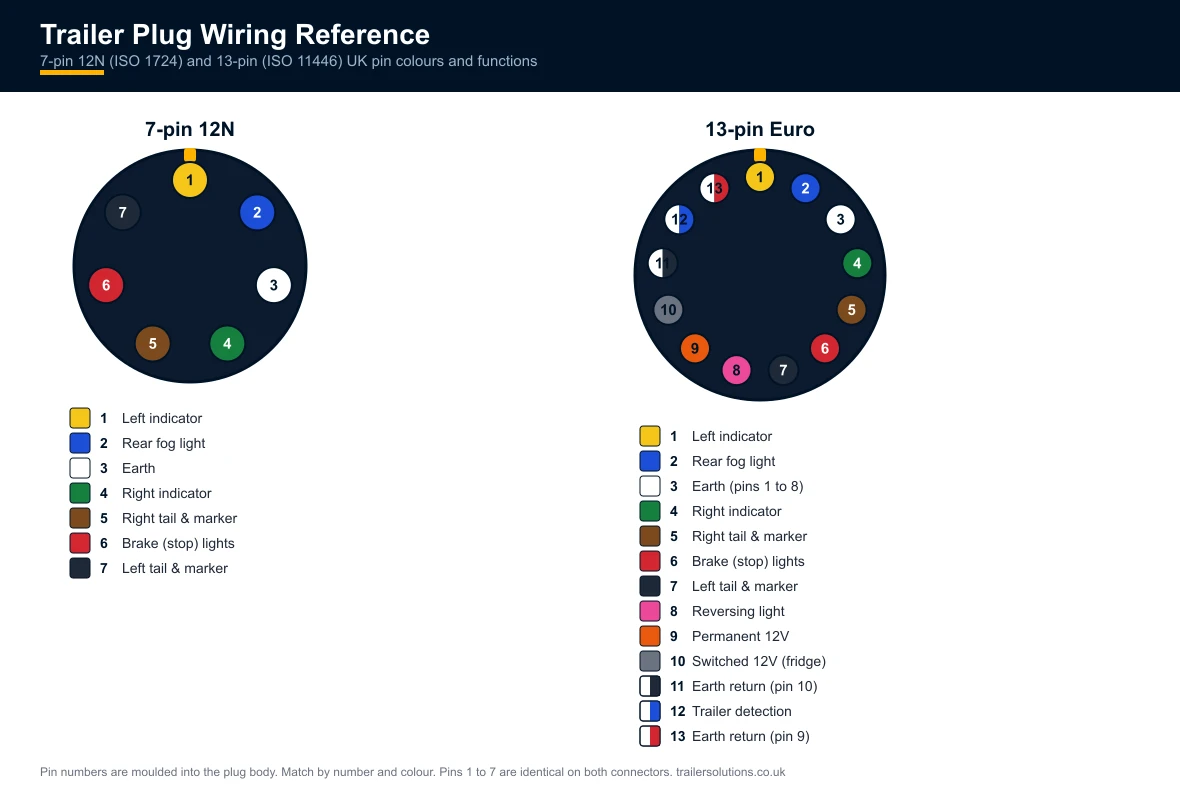
Below are the standard layouts. Always work to the colours and pin numbers, not to a photo, because a plug can be wired by hand and the previous owner may not have followed the standard.
7-pin 12N plug wiring (the standard road lights)
This is the black 7-pin plug fitted to the vast majority of goods trailers. It handles everything the law asks of you for towing on the road. Looking into the plug with the pins facing you, the standard 12N layout is:
| Pin | Colour | Function |
|---|---|---|
| 1 (L) | Yellow | Left indicator |
| 2 (54G) | Blue | Rear fog light |
| 3 (31) | White | Earth |
| 4 (R) | Green | Right indicator |
| 5 (58R) | Brown | Right tail and marker lights |
| 6 (54) | Red | Brake (stop) lights |
| 7 (58L) | Black | Left tail and marker lights |
A quick memory aid: the indicators sit on the outside pins, the earth is white and goes to pin 3, and the brake light is red on pin 6. If only one side of your tail lights is dead, it is almost always the brown or black wire, or the earth.
7-pin 12S plug wiring (the caravan extras)
The 12S is the grey 7-pin plug used alongside a 12N on older caravans and some powered trailers. It carries the “living” side: reversing light, a permanent 12V feed, a switched feed for a fridge or battery charger, and the earths that go with them. The exact function on a couple of pins changed over the years, so if you are wiring a caravan built around 2008 or earlier, check the unit’s own diagram before you commit. For most modern setups the 12S is replaced entirely by a single 13-pin plug.
13-pin plug wiring (12N and 12S in one)
The 13-pin Euro plug is now the standard on new caravans and many trailers. It rolls the road lights and the auxiliary circuits into one weatherproof connector, which is tidier and far less prone to corrosion than two separate plugs.
| Pin | Colour | Function |
|---|---|---|
| 1 | Yellow | Left indicator |
| 2 | Blue | Rear fog light |
| 3 | White | Earth for pins 1 to 8 |
| 4 | Green | Right indicator |
| 5 | Brown | Right tail and marker lights |
| 6 | Red | Brake (stop) lights |
| 7 | Black | Left tail and marker lights |
| 8 | Pink | Reversing light |
| 9 | Orange | Permanent 12V supply |
| 10 | Grey | Switched 12V (charging/fridge) |
| 11 | White/Black | Earth return for pin 10 |
| 12 | White/Blue | Signalling connection (trailer detection) |
| 13 | White/Red | Earth return for pin 9 |
Pins 1 to 7 mirror the 12N exactly, so if you can wire a 7-pin you already understand most of a 13-pin. Pins 8 to 13 are the extras.
Mixing 7-pin and 13-pin towing
If your towing vehicle and trailer have different plugs, you do not need to rewire anything. A simple adapter converts between them. We cover exactly which way round you need it, and the catch with twin 7-pin to 13-pin adapters, in our guide to 7-pin to 13-pin trailer adapters.
Common wiring faults to rule out
- One side dead: usually a broken brown or black wire, or a poor earth on the white pin.
- Nothing works at all: almost always the earth (pin 3 on a 7-pin), or a corroded plug face.
- Fast-flashing indicators after fitting LEDs: the vehicle has read the lower current as a bulb failure. That is normal and easily solved.
For a full walk-through of diagnosing dead or faulty lights, see trailer lights not working: a UK fault-finding guide. If your indicators have started flashing too quickly since you switched to LED, that is a known quirk covered in why are my LED trailer lights blinking, and it is sorted in minutes with a 68007 fault eliminator.
Wiring for LED lights
LED lamps wire to exactly the same pins and colours as bulb units, so a switch to LED does not change anything in this guide. They simply draw far less current, last longer and stay brighter in the wet. If you are upgrading, our range of LED rear lights and LED trailer lights are all E-marked and road-legal, and you can read how to pick the right units in our guide to choosing LED trailer lights.
Stuck on a connector or not sure which plug you have? Get in touch and we will talk it through.