
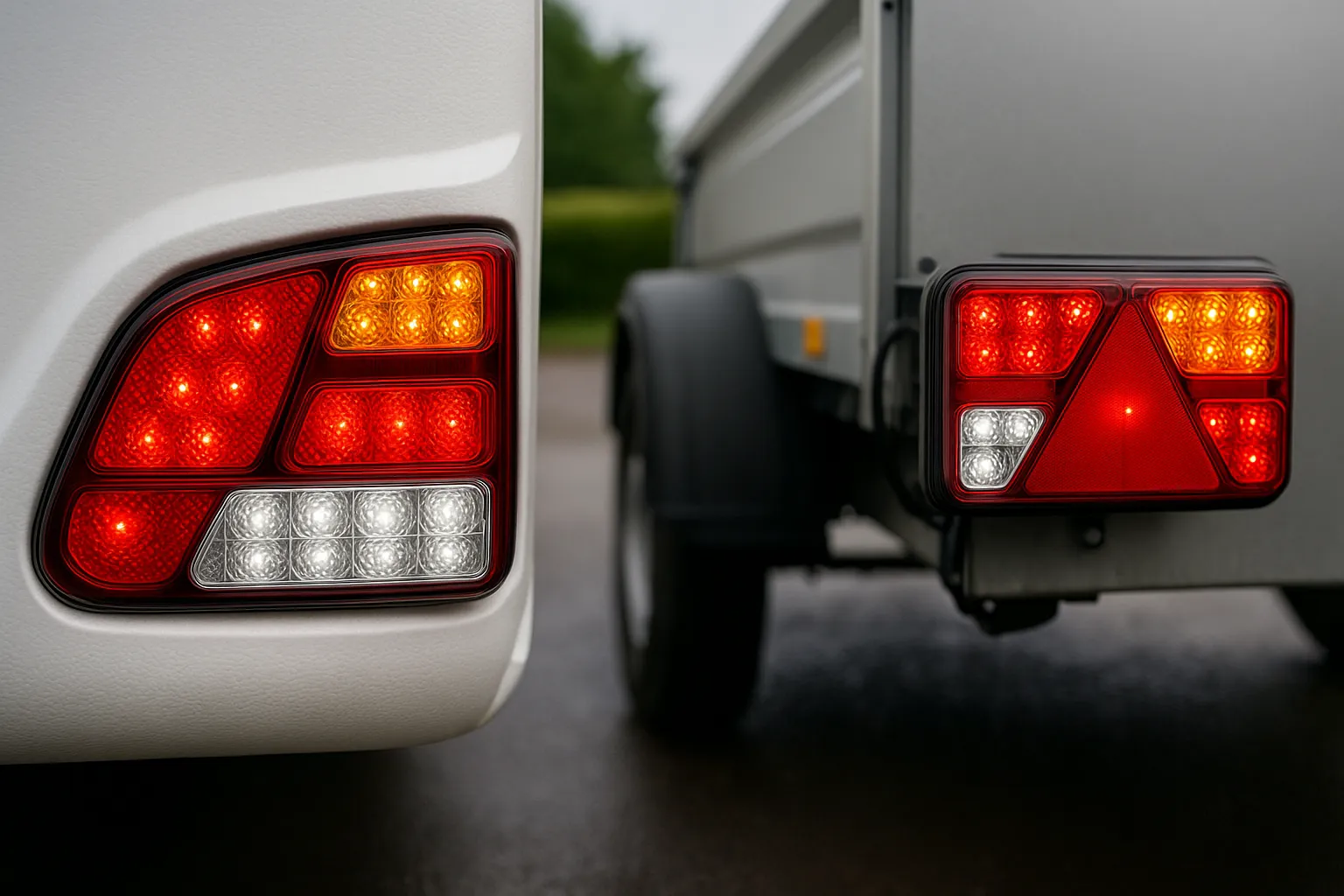
What are the UK lighting rules for trailers? This guide explains the essentials in plain English, with links to the official sources. We cover small/light trailers (including those around the 750 kg mark), larger leisure and commercial trailers, and then the headline requirements for HGV trailers. Wherever you sit, the key principle is simple: your trailer must be fitted with approved lamps/reflectors to the correct pattern, and every lamp must work whenever the vehicle is used on the road.
Primary law and guidance you should know:
- Road Vehicles Lighting Regulations 1989 (RVLR) – the legal backbone for lamps and reflectors.
- GOV.UK: Tow a trailer with a car – safety checks – practical pre-use advice for light trailers.
- DVSA MOT inspection manual (cars & light vans) – reasons for failure that also signal roadworthiness issues on towed trailers.
- DVSA Heavy Goods Vehicle Inspection Manual (PDF) – detailed checks for HGVs and their trailers.
Light trailers and caravans: under and over 750 kg
In everyday towing conversations, people often refer to “750 kg trailers”. That weight (Maximum Authorised Mass, sometimes called Maximum Permissible Mass) is a licensing and braking threshold, not a lighting exemption. Lighting rules still apply whether your trailer is under or over 750 kg. What changes with size/width is which specific lamps are required.
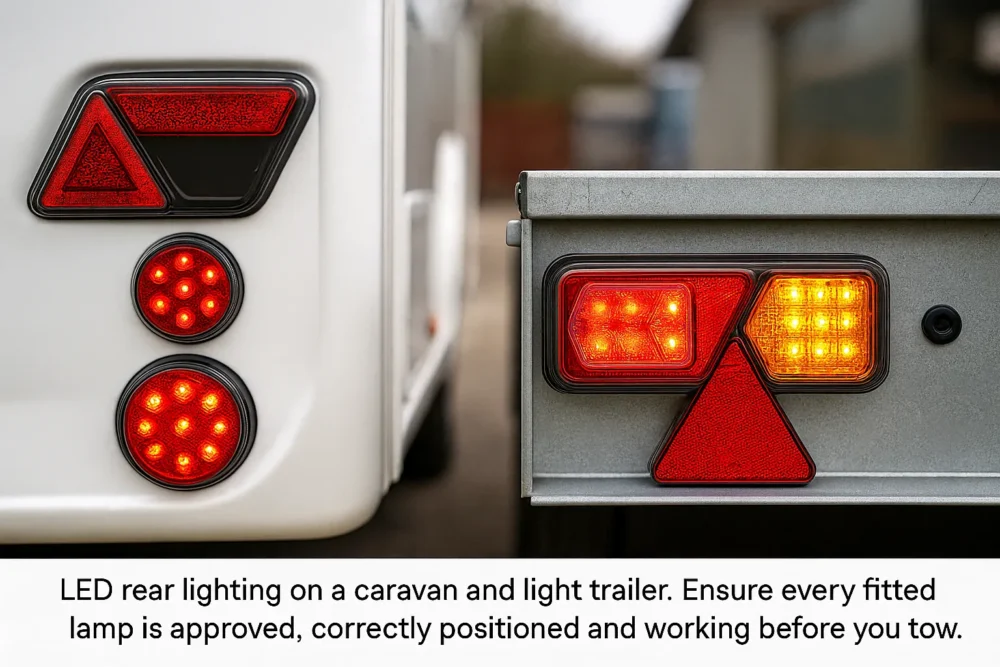
Core rear lighting for most UK light trailers (including caravans)
Unless a very narrow/special case applies, a road-going trailer or caravan in the UK will need, at the rear:
- Two red position (tail) lamps.
- Two red stop lamps.
- Two amber direction indicators, flashing 60–120 times per minute.
- Number-plate lamp illuminating the registration plate.
- Two red triangular reflectors (trailers require triangles – not permitted on the front). See RVLR schedules for the detail: reflectors.
Depending on size and date of manufacture, you may also require:
- Rear fog lamp(s) – generally required if the trailer is 1.3 m or wider; if one lamp is fitted it should be central or on the offside. See RVLR fog lamp schedule and Highway Code lighting rules: Highway Code.
- Reversing lamp – required on many braked trailers built from October 2012 (ECE compliance). Check your trailer’s approval/age.
- Front position lamps and white front reflectors – required on wider/modern trailers; fronts must never be triangular. See the MOT and HGV/DVSA manuals for placement tolerances.
- Side marker lamps – for longer trailers (generally over 6 m body length) and certain widths.
Practical pre-journey checks are set out clearly in GOV.UK’s guidance for car and trailer combinations. Before you tow, confirm that all lights and indicators work, lenses are secure and clean, and the number plate is visible and illuminated.
If you are building or significantly modifying a light trailer (O1/O2), DVSA’s IVA notes are helpful on common pitfalls such as lamp positioning, retro-reflectors and reverse lamps: IVA help to get a pass.
Need compliant LED lamps and technical advice? See our range and support:
- Trailer Safety Awareness training – practical compliance for businesses and individuals.
- Towing Solutions – UK training and support.
When the trailer gets larger: over 750 kg and up to 3.5 t
Once you move into heavier leisure or commercial trailers, the same core pattern applies, but placement tolerances and the likelihood of additional lamps increases. For example, a braked plant trailer around 2–3.5 t will typically have full rear functions (stop/tail/indicator/reverse/fog/reflector), number-plate lamp, white front reflectors, sometimes front position lamps, and side markers if the body length warrants it. If the trailer is used at night or in poor visibility without these working, you risk prohibition or prosecution under the RVLR and Construction & Use.
For cars and light vans, the MOT manual gives useful acceptance criteria for lamp condition, security and operation (which is a good proxy for roadworthiness checks): MOT manual section 4.
Choosing LEDs? Ensure E-marked/E-approved units with the correct functions, and install to the manufacturer’s instructions. If your tow vehicle shows bulb-failure warnings with LEDs, use a compatible load or smart interface. We can advise on suitable solutions as part of our Trailer Safety Awareness provision.
HGV trailers (O3/O4): headline lighting requirements
HGV trailers use 24 V systems and must meet more extensive lighting and conspicuity requirements. Key points:
- Rear lighting set: red position lamps, stop lamps, amber indicators, rear fog lamp(s), reversing lamp(s) where applicable, and red rear reflectors. Triangular reflectors remain mandatory for trailers.
- Front and side equipment: white front reflectors; front position lamps on wider trailers; side markers along the length for longer bodies; amber indicators with correct flash rate.
- Conspicuity markings (retro-reflective tape) are widely required on many N and O category vehicles to ECE standards. Although this guidance sits alongside lighting law rather than inside the RVLR itself, it is enforced at annual test and roadside by DVSA.
- Condition and operation: the DVSA HGV Inspection Manual sets out defects, positioning tolerances and reasons for failure for lamps and reflectors, including front/side/rear reflectors, tell-tales, and wiring.
Operators must also complete daily walk-around checks and maintain records to keep trailers roadworthy. Lighting defects are a common cause of prohibitions. If your fleet uses mixed-duty trailers (site shunters, highway plant, etc.), consider dual-voltage LED solutions and robust sealed connectors to reduce failures.
Frequently asked questions
Do I need triangular reflectors? Yes. UK/EU trailers require red triangular rear reflectors. Triangles must not be fitted at the front; white non-triangular reflectors are used there instead. See RVLR reflector schedules.
Is a rear fog lamp mandatory? If the trailer is 1.3 m or wider, at least one red rear fog lamp is generally required; if a single fog lamp is fitted it must be central or on the offside. See RVLR: rear fog lamps and the Highway Code for correct use.
What about reversing lights? Many newer braked trailers (and most HGV trailers) require a reversing lamp as part of type-approval. Check your trailer’s age and approval plate.
Do laws differ for 12 V and 24 V? No. The law is function-based. Voltage choice is engineering; compliance depends on having the right approved lamps, in the right places, working correctly.
Next steps and support
- Read the core law: Road Vehicles Lighting Regulations 1989.
- Check your combo before every journey: GOV.UK trailer safety checks.
- For training on legal towing, daily checks and fault-finding, see Towing Solutions – Trailer Safety Awareness.
- Contact us for help specifying E-marked LED lamps, dual-voltage options and wiring best practice: Towing Solutions.
This article is a general guide to UK lighting requirements for trailers. Always consult the RVLR, the relevant DVSA manuals and your trailer’s approval documents for full legal details.