
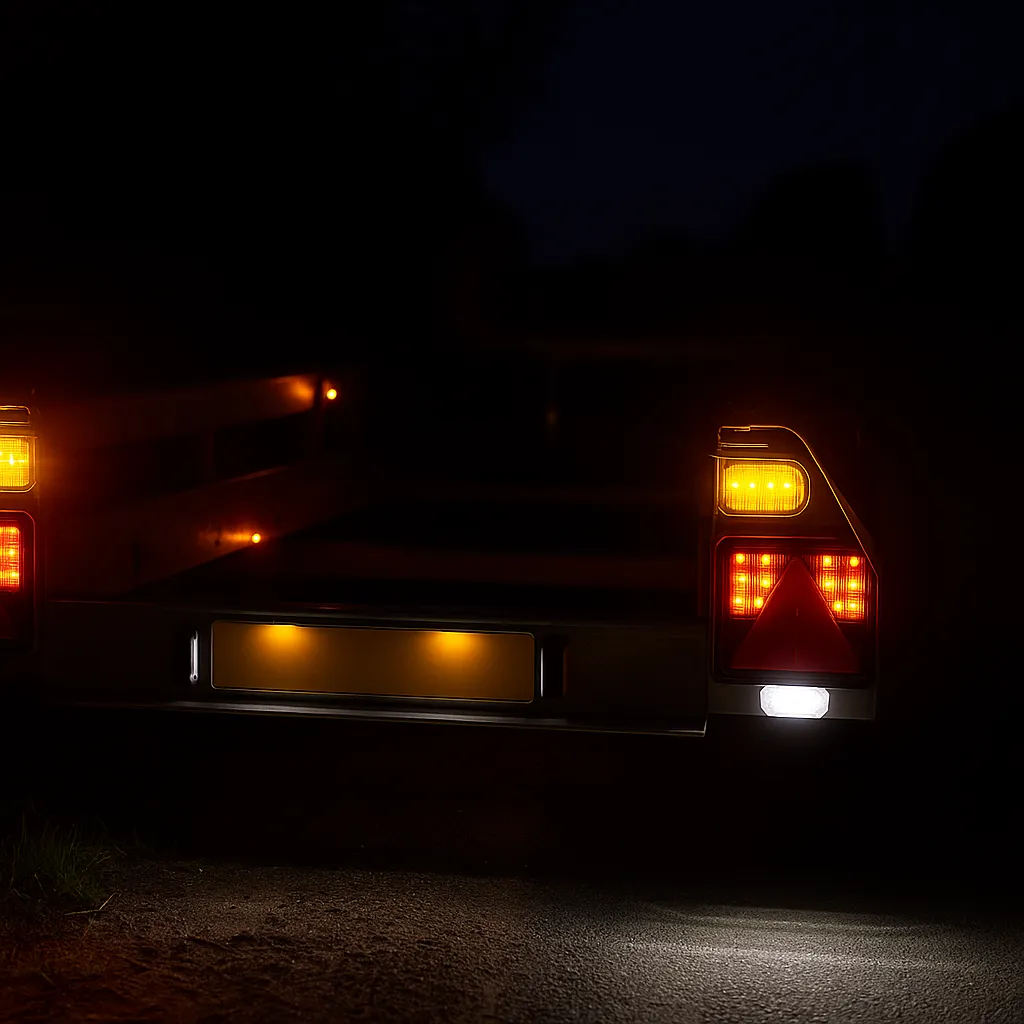
LED lights are now the standard across UK trailers, caravans and HGVs, but many trailer owners—along with some builders and DIY installers—aren’t sure exactly what the law requires. With cheap non-compliant imports now widely sold online, it’s more important than ever to understand how UK lighting legislation works, how brightness is regulated, and why using approved Lucidity LED lights ensures you remain fully compliant and visible on the road.
This guide explains how LED lighting affects UK roads, what the law says about brightness and approval markings, and why choosing high-quality, E-marked lamps dramatically reduces the chances of roadside prohibitions, MOT issues, or dangerous visibility failures.
Why LED lighting matters on UK roads
LEDs offer clear safety advantages over old incandescent trailer lamps:
- Faster response time: LEDs reach full brightness in milliseconds, helping following vehicles react quicker—especially to brake lights.
- Brighter, more consistent illumination: Good LEDs maintain output even at lower voltages, giving consistent visibility.
- Lower power draw: Reduces strain on tow vehicle electrics and improves reliability.
- Longer lifespan: Quality LEDs often exceed 30,000 hours, reducing maintenance and downtime.
However, these benefits only work if the lights used are properly approved, correctly positioned, and of the right brightness. Cheap, over-bright or under-powered lamps can create glare, fail lighting tests, or simply burn out prematurely.
UK law: what LED lights MUST comply with
In the UK, any lamp used on a road-going trailer, caravan or HGV must meet the Road Vehicles Lighting Regulations 1989 (RVLR). This includes rules for brightness, positioning, colour, angles of visibility, and which lights must be fitted to which class of vehicle.
The key legal requirements for road-use LED lights include:
- E-mark certification: Every road-going LED must display an E-mark (e.g., E4, E11) showing it meets European/UK approval standards. No E-mark = not legal for road use.
- Correct photometric brightness: Brake lights, indicators and tail lamps must fall within strict minimum and maximum brightness ranges. Too dim is unsafe; too bright can be illegal glare.
- Colour accuracy: Red must be red, amber must be amber, white must be white—no tinted, colour-shifted, or RGB lamps on road trailers.
- Mandatory functions: Rear fog lamps, triangular reflectors, number plate illumination, front markers, side markers and reverse lamps must be used where required by the RVLR.
- Correct positioning: Height, width, and spacing rules apply. For example, rear fog lamps must be central or on the offside; triangular reflectors must point up; markers must be visible within specific angles.
Full details of lamp types and legal functions appear in the RVLR schedules, including:
- Stop lamps (Schedule 7)
- Direction indicators (Schedule 6)
- Rear fog lamps (Schedule 11)
- Reflectors (Schedule 18)
Brightness rules: what does the law actually say?
One of the most misunderstood areas is LED brightness. Many unapproved LEDs are dangerously bright, lacking proper beam control. The law is clear:
LED brightness (luminous intensity) must fall within approved photometric limits for each lamp function.
These limits are defined in UN ECE Regulations, which the UK still adopts:
- ECE R7: Position/tail lamps
- ECE R6: Direction indicators
- ECE R38: Rear fog lamps
- ECE R23: Reverse lamps
If a lamp exceeds or falls short of these limits, it cannot legally be fitted to a road-going trailer. This means:
- You cannot use ultra-bright “off-road LED bars” as road-use brake lights.
- You cannot use dim “budget imports” as tail lamps or indicators.
- You cannot replace a fog lamp with a non-approved red lamp.
The DVSA MOT inspection manual also enforces these brightness rules—any trailer presented for testing (or observed on the road) may be prohibited if lamps are too dim, incorrectly coloured, or incorrectly aligned.
Why cheap LED lights are a growing problem on UK roads
Many low-cost LED lamps sold via online marketplaces fail the most basic approval checks. Common issues include:
- No E-mark or fake E-mark.
- Incorrect brightness (too dim or far too bright).
- Poor beam control leading to glare.
- Low ingress protection (e.g., IP44) causing water damage within weeks.
- Thin wiring and poor solder joints increasing the risk of open circuits.
These unsafe lights contribute to rising numbers of roadside defects. DVSA officers frequently issue prohibition notices for faulty trailer lighting—one of the top causes of stopped vehicles during roadside checks.
Why Lucidity LEDs are better — and fully UK compliant
Lucidity is one of the world’s leading OEM-grade manufacturers of road-legal LED lights for trucks, trailers and caravans. Unlike low-cost imports, every Lucidity lamp used for road lighting is:
- Fully E-marked to the correct ECE Regulation.
- Photometrically tested to ensure perfect brightness levels.
- Designed with strict beam control to avoid glare and improve safety.
- Multi-voltage (12/24V) to suit cars, 4x4s, HGVs and plant.
- IP67 or IP69K sealed for water, dust and pressure-wash resistance.
- Built with OEM-grade connectors (AMP, bayonet, Superseal) for secure fitting.
These benefits translate directly into safer UK roads:
- Better visibility for following traffic during braking and signalling.
- Fewer roadside defects thanks to robust sealing and long life.
- Improved compliance with RVLR and type-approval rules.
- Less downtime for fleets and caravan owners.
Where can you find approved Lucidity lights?
Lucidity LED lighting is available in the UK through Trailer Solutions, with a full online range of road-legal, E-marked lamps for caravans, light trailers, plant, and HGV applications.
You can browse the product range here:
For training on safe towing, road-legal lighting, electrics and fault-finding, visit our sister company (separate business):
Towing Solutions – Trailer Safety Awareness Courses
Frequently asked questions
Are all LED lights legal for UK roads?
No. Only E-marked LED lamps approved to the relevant ECE standard are legal. Off-road bars, non-approved red lights, and unmarked imports are not road-legal.
How do I check brightness legality?
You cannot easily test brightness at home, but you can check the E-mark code on the lamp. If it is approved to ECE R7 (tail), R6 (indicator) etc., the brightness has already passed formal photometric tests.
What happens if I tow with an illegal light?
You risk prohibition, fines, MOT failure, insurance issues, and reduced visibility on the road. DVSA routinely stops trailers for lighting defects.
Are LED fog lamps allowed?
Yes, as long as they are E-marked to ECE R38 and correctly positioned (centre or offside, not nearside only). See RVLR Schedule 11.
Summary: safer roads start with compliant LEDs
LED lights make UK roads safer, but only when they are approved, correctly positioned and properly maintained. The RVLR and ECE regulations set strict brightness and performance standards for a reason: visibility saves lives. Using cheap, unapproved lamps can put you and other road users at risk.
Lucidity LEDs offer peace of mind by combining OEM-grade build quality with full legal compliance — ensuring your trailer, caravan or HGV remains safe, bright and road-legal in all conditions.
Need help choosing compliant LED lights?
- Browse the Lucidity LED range at Trailer Solutions
- Get product advice for your trailer, caravan or fleet
- Learn towing & electrics with Towing Solutions (separate company)
This guide is for road-going vehicles in the United Kingdom. Always follow the RVLR, ECE approvals and DVSA guidance when selecting and installing LED lighting.