

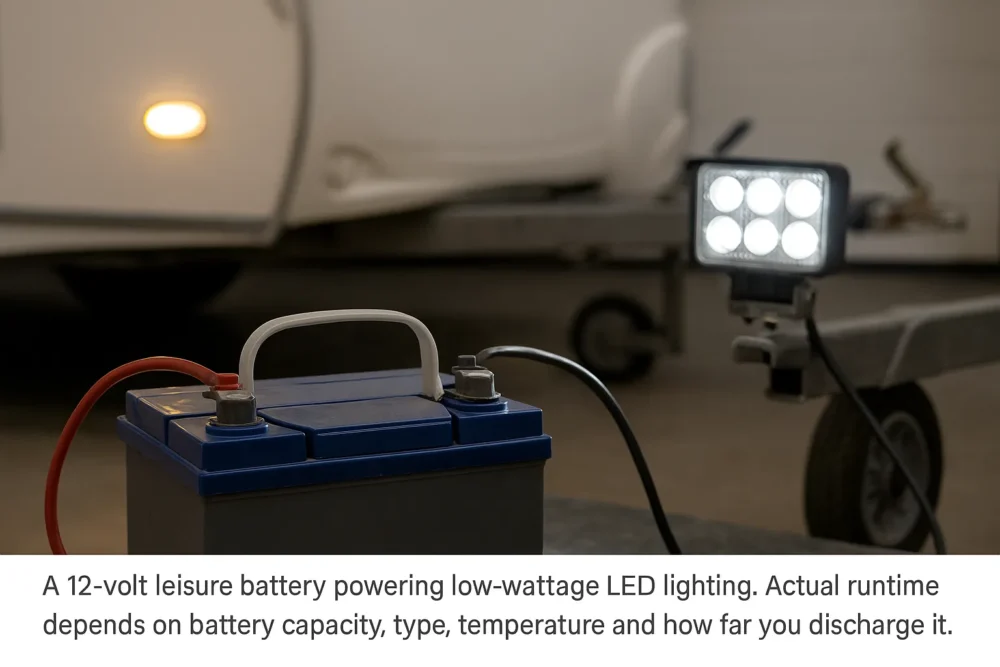
How long can a 12-volt battery run an LED light? The short answer is: use the light’s power (watts), the battery’s capacity (amp-hours), and a sensible allowance for real-world losses. In this practical UK guide we show you the exact calculation, give worked examples for common lamp sizes, and explain why battery type (leisure lead-acid vs lithium), temperature and depth-of-discharge (DoD) matter.
Legal note (UK roads): if you are using lights on a trailer or caravan while driving on public roads, they must meet the Road Vehicles Lighting Regulations 1989 and be powered via the tow vehicle’s 7-pin or 13-pin socket. Separate battery-powered road lights are not acceptable for mandatory rear lighting. See also GOV.UK guidance on trailer lighting checks.
Quick rule of thumb
Runtime in hours ≈ (Battery Ah × Usable DoD × System efficiency × 12) ÷ LED watts.
- Battery Ah: the rated capacity (e.g., 100 Ah leisure battery).
- Usable DoD: how much of the battery you’re willing to use. For long life: ~50% for flooded/AGM leisure lead-acid; up to ~80–90% for LiFePO4.
- System efficiency (η): allow ~0.85–0.9 for cable and driver losses (lower if using an inverter).
- 12: nominal system voltage (we assume 12.0 V for the estimate).
Example (simple): 100 Ah AGM leisure battery, 50% DoD, 90% efficiency, powering a 10 W LED work lamp: Runtime ≈ (100 × 0.5 × 0.9 × 12) ÷ 10 = 54 hours (best-case estimate; see “real-world factors” below).
The exact calculation (step-by-step)
- Find the LED power (W): e.g., a lamp marked “10 W”.
- Convert watts to current: I = W ÷ V. At 12 V, 10 W ≈ 0.83 A.
- Work out usable battery capacity: usable Ah = Rated Ah × DoD × η.
Example: 100 Ah × 0.5 × 0.9 = 45 Ah usable. - Runtime: usable Ah ÷ current. Example: 45 Ah ÷ 0.83 A ≈ 54 hours.
Worked examples (common LED sizes)
| LED load | Current at 12 V | Runtime on 100 Ah lead-acid (50% DoD, η=0.9) | Runtime on 100 Ah LiFePO4 (80% DoD, η=0.92) |
|---|---|---|---|
| 5 W LED strip | 0.42 A | (100×0.5×0.9) / 0.42 ≈ 107 h | (100×0.8×0.92) / 0.42 ≈ 175 h |
| 10 W work light | 0.83 A | 54 h | 89 h |
| 20 W area light | 1.67 A | 27 h | 44 h |
| 40 W awning / flood | 3.33 A | 13.5 h | 22 h |
These are estimates at room temperature with healthy batteries. Expect less runtime in cold weather, with older batteries, or if your wiring/inverter is inefficient.
Battery types and why they matter
Leisure lead-acid (flooded, AGM, gel)
- Affordable and widely available for caravans and light trailers.
- Prefer shallow cycles for long life. As a simple rule, use ~50% DoD for routine use.
- Capacity falls in the cold; voltage sag increases near empty.
- Peukert effect: at higher currents the effective capacity drops; insignificant for tiny LED loads, but worth noting for larger appliances.
LiFePO4 (lithium iron phosphate)
- Higher usable DoD (often 80–90%) and flatter voltage curve.
- Lighter and better cycle life, but needs a proper BMS and compatible charger.
- Performance dips in very low temperatures; check charge limits.
Real-world factors that reduce runtime
- Temperature: Lead-acid can lose 20–30% of capacity near 0 °C; lithium also derates when cold (especially for charging).
- State of health: Older batteries rarely deliver their label capacity. Test or derate by 10–30% if age/usage is unknown.
- Voltage drop & wiring: Long thin cables waste power as heat. Use appropriate cable size and good earths.
- Drivers & inverters: DC-DC LED drivers are fairly efficient, but a 230 V inverter can waste 10–15% (or more at light loads).
- Standby loads: USB chargers, trackers and control panels nibble away at capacity; include them in your estimate.
Multiple lights? Just add the watts
If you run several lamps, total the wattage. Example: two 10 W work lights and one 5 W strip = 25 W total. Current ≈ 25 ÷ 12 = 2.08 A. Using our 100 Ah AGM case (45 Ah usable), runtime ≈ 45 ÷ 2.08 ≈ 21.6 hours.
Charging, safety and UK guidance
- On the road: Trailer/caravan mandatory lamps must be powered via the tow vehicle and meet the RVLR. See GOV.UK’s trailer lighting checks.
- Battery charging safety: Follow safe charging practice and ventilation advice. The HSE provides general guidance on electrical safety and battery charging in workplaces: start with HSE electricity guidance and your charger’s manual.
- Waste & recycling: Don’t bin old batteries. Use approved facilities – see GOV.UK: waste batteries and your local authority recycling pages.
Frequently asked questions
Can I use a car starter battery? It will work, but starter batteries dislike deep discharge and wear out quickly. A leisure (deep-cycle) battery is the better choice for lighting.
Will my alternator or 13-pin socket recharge the leisure battery while towing? Many modern caravans/trailers are wired to support charging via the 13-pin system (permanent live and fridge feed). Output varies; treat it as a top-up, not a rapid charge.
Do LED lights always save power? Yes, compared with equivalent halogen or incandescent lamps. But driver electronics, dimmers and inverters can add overheads, so use DC LED lighting where possible.
What depth of discharge should I use? For lead-acid, plan around 50% for longevity; for LiFePO4, up to 80–90% is typical if the BMS and temperatures allow.
Summary
To estimate how long a 12-volt battery will run an LED light, convert the lamp’s watts to amps, decide how much of the battery you’ll use (DoD), allow for efficiency losses, and divide usable amp-hours by current. A healthy 100 Ah leisure battery can run a single 10 W LED for roughly two days; a LiFePO4 of the same size could stretch near four, all else equal. For road use in the UK, remember that trailer and caravan road lights must be vehicle-powered and compliant with the RVLR; keep battery-only lighting for off-road or campsite use.
Need parts or advice?
- Looking for E-approved LED rear lamps, side markers and number-plate lights? Browse our range.
- Want hands-on training in safe towing, electrics and fault-finding? Our sister company Towing Solutions Ltd provides IMI-aligned courses in the UK.
- Have a mixed-fleet electrical question? Contact Trailer Solutions for practical, product-specific help.